
Hospital at Home: what home hospitalization is and why it is a validated clinical model
Home hospitalization, also known as Hospital at Home, is a care model that allows providing acute hospital care in the patient's home, substituting conventional hospital admission in a safe and structured way. Far from being a form of basic home care, this model is backed by scientific evidence and by international reference health institutions, which recognize it as a valid clinical alternative for certain patient profiles.
What is Hospital at Home or home hospitalization?
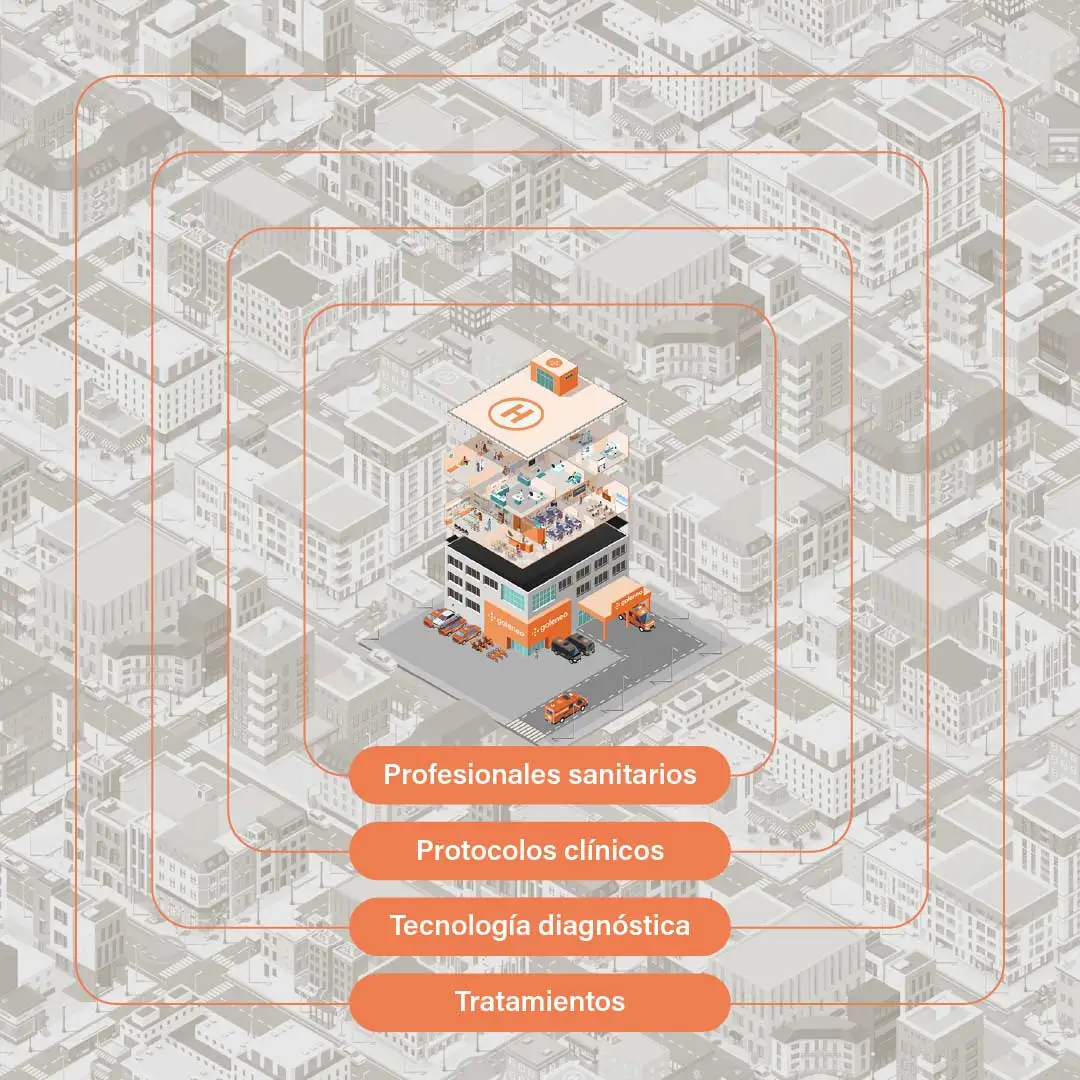
The Hospital at Home model is defined as the provision of complete hospital care at home, with the same clinical responsibility, therapeutic capacity, and medical supervision as a traditional hospital admission. According to the international consensus promoted by the World Hospital at Home Community, this type of hospitalization implies transferring to the patient's home the healthcare professionals, clinical protocols, diagnostic technology, and necessary treatments to manage an acute disease episode, temporarily and with continuous medical control. The key to the model is not the place where care is provided, but the level of clinical complexity, which remains hospital-level.
Hospital at Home versus other home care models
One of the most relevant, and often least understood, aspects is the difference between hospital at home and other home services. Home hospitalization replaces a real hospital admission. The patient is officially hospitalized, although care is provided in their home. There is integral clinical responsibility, with structured medical follow-up, therapeutic decision-making, and a formal hospital discharge. This clearly differentiates it from conventional home care, usually oriented to the follow-up of chronic patients, long-term care, or support after discharge, without assuming the management of a complex acute episode.
How does the Hospital at Home model work?

1. Clinical patient selection
Access to hospital at home is based on well-defined clinical criteria. Patients must be clinically stable, but require hospital care that would otherwise justify a conventional admission. Evidence indicates that correct selection is fundamental to ensure clinical results equivalent or superior to those of the traditional hospital.
2. Hospital care at home
Once included in the program, the patient receives medical and nursing care at home with the capacity to administer intravenous treatments, perform diagnostic tests, monitor vital signs, and adjust therapy continuously. Models such as the one developed by Mayo Clinic integrate face-to-face visits with remote monitoring, guaranteeing permanent care availability and a rapid response to any clinical change.
3. Safety and care continuity
The home is integrated into the hospital circuit. There are clear escalation protocols that allow immediate transfer to the hospital if the clinical situation requires it, keeping patient safety as a priority.
4. Scientific evidence of Hospital at Home
Hospital at home is not an experimental model. Systematic reviews, such as those published by the Cochrane Library, have shown that this approach offers clinical results comparable to conventional hospitalization in terms of mortality and safety, and can be associated with a higher probability of remaining at home after the acute episode. Studies published in journals like CMAJ also underline relevant benefits in patient experience, a reduction in complications associated with the hospital environment, and a more efficient use of healthcare resources, especially in the adult population and the elderly.
Clinical and organizational benefits of hospital at home
From a clinical perspective, the Hospital at Home model allows reducing risks inherent to the hospital environment, such as nosocomial infections, and favors recovery in a more familiar environment. From the health system point of view, it represents an effective tool to optimize hospital beds, reduce unnecessary stays, and advance towards more sustainable care models, without compromising care quality.
Limitations and challenges of the model
Despite its potential, hospital at home is not applicable to all patients or all clinical situations. It requires a solid organizational infrastructure, specialized teams, technological integration, and close coordination with the reference hospital. In addition, the patient's social and home context must allow for safe care, which makes an individualized assessment essential in each case.
Hospital at Home: an evolution of the traditional hospital
The Hospital at Home model represents a natural evolution of the hospital, aligned with the current challenges of the healthcare system: population aging, care pressure, and the need for more person-centered care. Available evidence supports its implementation as a serious, safe, and effective clinical model when applied with rigorous criteria and an appropriate care structure.
Discover more about our Hospital at Home service. Visit our services page or contact us directly.
Bibliography
- Definition: What is Hospital at Home? | WHAHC. (s. f.). https://whahc-community.kenes.com/mod/page/view.php?id=1042
- Advanced Care at home - Overview. (s. f.). Mayo Clinic. https://www.mayoclinic.org/departments-centers/hospital-at-home/sections/overview/ovc-20551797
- *Shepperd, S., & Iliffe, S. (2005). Hospital at home versus in-patient hospital care. Cochrane Database Of Systematic Reviews. https://doi.org/10.1002/14651858.cd000356.pub2 *
- Leff, B. (2009). Defining and disseminating the hospital-at-home model. Canadian Medical Association Journal, 180(2), 156–157. https://doi.org/10.1503/cmaj.081891